

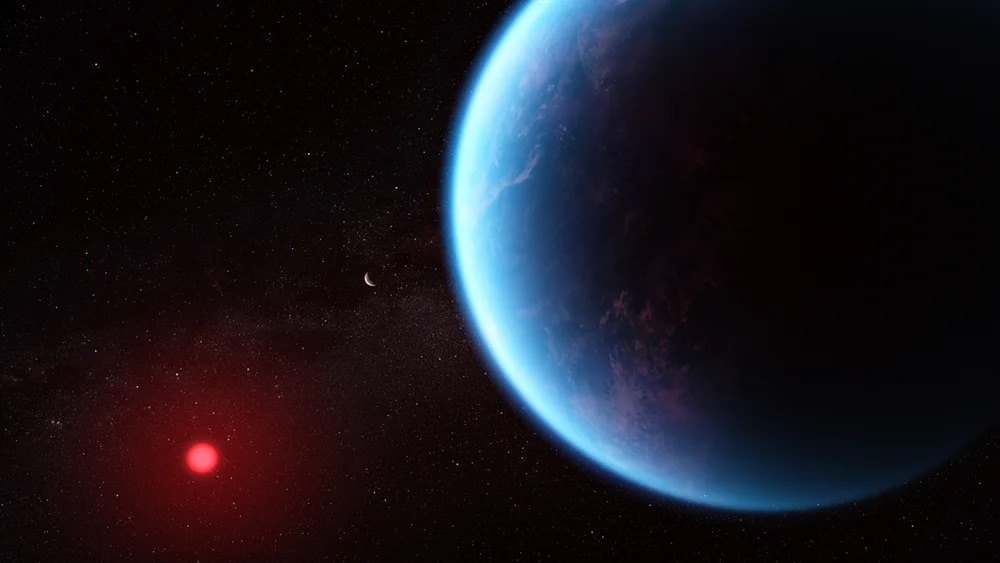
As we mark the annual celebration of Earth Day, honoring our common home, Mother Earth, and the ecological balance that sustains all life, there is news that scientists may have found, for the first time, genuine proof of life on another planet. Using the powerful James Webb Space Telescope, scientists detected chemical signatures associated with living organisms.
As the BBC reports:
A Cambridge team studying the atmosphere of a planet called K2-18b has detected signs of molecules which on Earth are only produced by simple organisms.
This is the second, and more promising, time chemicals associated with life have been detected in the planet’s atmosphere by Nasa’s James Webb Space Telescope (JWST).
NASA explains how the Webb Telescope is searching for signs of life, and how challenging that work is:
With its unprecedented infrared sensitivity and resolution, Webb observes small, rocky, potentially habitable planets outside our solar system in more detail than ever before. It can detect whether these planets have atmospheres and, critically, begin to study the chemical composition of those atmospheres, offering clues about habitability and potential biosignatures, such as gases that may have been produced by life. However, finding biosignatures is challenging for Webb – this requires potentially hundreds of hours of observing time for a single planet.
Today, alongside Earth Day meetings at the United Nations, my friend and colleague Myra Jackson told me that the biosignatures (evidence of dimethyl sulfide) that appear to be linked to planet K2-18b are like those produced on Earth by corals, plankton, and other marine organisms. That would suggest more evolved life and biodiverse ecosystems, along with potential marine environments like those we have on Earth. It is too soon to know if this observational data truly indicates life, and it may be impossible to prove, given all that we cannot know about a planet and a star system so far away, but it is a stark reminder of the importance of caring for the habitable planet we do know.
So, what is the state of things here?
- 2024 was the hottest year on record, and appears to have jolted our home planet into a new climate state, with average global heating near 1.5ºC above pre-industrial levels, and signs of accelerated heating due to compounding nature loss, ice melt, and atmospheric change.
- 2024 also saw the largest jump in climate-disrupting carbon pollution since the global Climate Convention was agreed in 1992; while some dismiss this as an irrationally exuberant post-pandemic rebound effect, the trends are going very much in the wrong direction in 2025.
- Plastic in the oceans has doubled since the year 2000, even as important work to protect the ocean as a global commons advances, and efforts to build zero pollution business models gather pace.
- Hundreds of millions of people face some level of ongoing food insecurity or acute hunger. Access to food that is reliably nutritious, health-building, and sustainably produced, is worryingly restricted, and major economic and trade policies that could change that look set to reinforce the status quo.
- Meanwhile, the Food System Economics Commission’s findings tally $138.3 trillion lost to the hidden costs of unsustainable food systems, since the Paris Agreement was signed, 9 years ago today.
In support of a gathering of stakeholders and Member States at the U.N. today, I shared a statement on the importance of living well in harmony with Nature, a special moment to highlight the importance of the work of tens of thousands of dedicated advocates across the world to support a future of integral ecology, as called for by Pope Francis in his landmark 2015 Encyclical, Laudato Si’.
At this crucial moment, we announced the formation of a Climate Action and Food Systems Alliance (CAFSA.net), to foster insight-sharing and innovation, through policy, local capacity building, economic development, and financial innovation. The aim of CAFSA will be to pull together the networks that are each developing key ingredients of the various diversified local food economies that are best suited to climate-resilient development in different locations.
Some political leaders are betting they can put global progress toward responsible environrmental stewardship to sleep with corrupt deals, menacing threats, and a record-breaking burst of pollution-oriented investment. Though these actions will cause real-world harm, they will not end the global push for environmental responsibility. They cannot, because without a thriving natural environment, human thriving ceases to be possible.
Maybe we are not alone in the universe. Maybe on at least one other world, 124 light-years away, there is life. Maybe it is everywhere. But we are still creatures of Earth, bound to Earth, with all that we value, know, dream, and love, rooted here. It is our task to invent and activate the Earth-friendly industrial and financial systems we need to keep Earth friendly to life as we know it.

 Geoversiv Earth Intelligence